
OUR DENTIST WILL FIND THE BEST OPTION FOR YOU

Which Full-Arch Solution Fits You?
If you’re missing most or all of your teeth, you have more options today than a single “implants or dentures” choice. All-on-4® dental implants, traditional dentures, snap-on dentures, mini dental implants, and All-on-6 all solve the same problem, tooth loss, in different ways, at different price points, with different tradeoffs. At Renaissance Dental Care, our implant dentist in Rancho Cucamonga, Dr. Jay Stockdale, helps patients throughout the Inland Empire compare these options side by side so you can choose with confidence, not guesswork.
Below, we break down how All-on-4 stacks up against every major alternative—cost, comfort, bone requirements, and long-term value—so you know exactly what you’re choosing between before your consultation.
To learn whether All-on-4 is right for you, call our Rancho Cucamonga dental office at (909) 297-1921 to schedule a consultation. We proudly serve patients near you throughout Rancho Cucamonga, Riverside, San Bernardino, Diamond Bar, and the surrounding Inland Empire communities.
Why Rancho Cucamonga Patients Choose Dr. Stockdale
Dr. Jay Stockdale has completed advanced implant training, including a mini-residency in implant placement and restoration at the University of Southern California, and continues ongoing education in implant, cosmetic, and restorative dentistry every year. Renaissance Dental Care uses Nobel Biocare implant systems, one of the most researched and widely used implant brands in full-arch dentistry, and offers nitrous oxide and oral conscious sedation for patients who feel anxious about the dental implant procedure.
We also offer transparent, upfront pricing and work with CareCredit and Lending Tree financing, so cost doesn’t have to be a barrier to restoring your smile.

What Is All-on-4®?
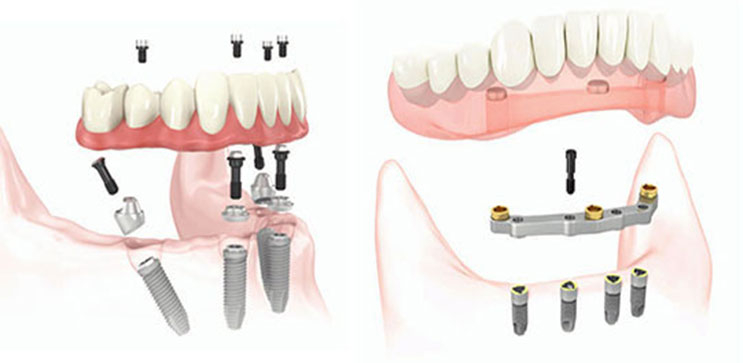
All-on-4 dental implants replace a full arch of missing teeth using just four strategically placed implants—two positioned vertically toward the front of the jaw and two placed at an angle toward the back, where bone is typically denser. This angled placement is what allows many patients to avoid a bone graft even with some jawbone loss and is why All-on-4 is often called “teeth in a day”: a temporary fixed arch can frequently be attached the same day as implant placement, so you’re not left without teeth during healing.
All-on-4 Implants vs. Traditional Dentures
While dentures have been a popular tooth replacement option for years, they come with several disadvantages that All-on-4 implants effectively address:
All-on-4 vs. Conventional (Removable) Dentures
Traditional dentures rest on the gums rather than anchoring to the jawbone. Over time, that means:
- They can slip, click, or shift, especially while eating or speaking
- Adhesives are often needed to keep them in place
- Because there’s no implant stimulating the bone, the jawbone continues to shrink, which changes the shape of the face over time
- Most conventional dentures need relining or replacing every five to seven years
All-on-4 implants are anchored directly to the jaw, so they don’t move, don’t require adhesive, and help preserve bone structure by stimulating it the way natural tooth roots do.
All-on-4 vs. Snap-On (Snap-In) Dentures
Snap-on dentures, also called implant-retained overdentures, are a middle-ground option. Two to four implants are placed in the jaw, and a removable denture clips onto them.
- Cost: Lower upfront cost than All-on-4, since fewer implants and a simpler prosthetic are involved
- Stability: More secure than conventional dentures, but still removable—patients take them out nightly for cleaning
- Longevity: The denture itself typically needs replacement every 5–10 years, plus periodic relines and attachment repairs
- Feel: Because the denture still rests partly on the gum tissue, it doesn’t distribute bite force as evenly as a fixed prosthesis
If a lower initial cost matters most and you don’t mind removing your teeth daily, snap-on dentures are worth discussing. If you want a fixed, non-removable solution that functions like natural teeth, All-on-4 is the stronger long-term fit.
All-on-4 vs. Mini Dental Implants
Mini dental implants are a narrower, less invasive implant option, most often used to stabilize a lower denture rather than replace a full arch outright.
- A smaller diameter means a simpler placement procedure with less bone required
- Because they’re narrower, mini implants generally can’t support the same bite force as full-sized implants over the long term
- There’s less long-term research on mini-implants compared to standard implants or All-on-4
- Best suited for patients who aren’t candidates for larger implants due to limited bone, rather than as a first-choice full-arch solution
All-on-4 vs. All-on-6
All-on-6 uses the same fixed-bridge concept as All-on-4, but with two additional implants for extra support.
- Bone requirements: All-on-4 was designed specifically to work with less available bone, thanks to the angled rear implants; All-on-6 typically needs more bone volume throughout the arch
- Cost: All-on-6 usually costs more due to the additional implants and surgical time
- Best for: Patients with strong, healthy bone and higher bite forces may benefit from the added stability of All-on-6; patients with bone loss who want to avoid grafting often do better with All-on-4
Your dentist will determine which fits your jaw structure using a CT scan and bite analysis at your consultation.
All-on-4 vs. Traditional Implants (Individual Implants/Implant Bridge)
Traditional full-arch restoration uses six or more individually placed implants spaced evenly across the jaw to support the bite load. This typically requires more available bone than All-on-4 and, for patients with bone loss, often means a bone graft is needed before implants can be placed at all. All-on-4’s angled implant design was developed specifically to reduce or eliminate that extra grafting step, which is one reason it’s become the preferred full-arch option for patients who were previously told they “didn’t have enough bone” for implants.
Quick Comparison at a Glance
| Option | Implants Needed | Removable? | Bone Graft Likely? | Typical Lifespan |
| Conventional Dentures | None | Yes | N/A | 5–7 years |
| Snap-On Dentures | 2–4 | Yes | Sometimes | 5–10 years (denture); implants can last longer |
| Mini Dental Implants | Multiple, narrow | Often removable | Rarely | Varies; less long-term data |
| All-on-4® | 4 | No — fixed | Often avoided | Implants 20+ years; prosthetic 10–15 years |
| All-on-6 | 6 | No — fixed | Sometimes | Similar to All-on-4, added stability |
Frequently Asked Questions
Is there an implant dentist near me in Rancho Cucamonga who treats bone loss?
Yes. Dr. Stockdale routinely treats patients throughout Rancho Cucamonga, Fontana, Ontario, Upland, Riverside, San Bernardino, and Diamond Bar who have been told elsewhere they don’t have enough jawbone for implants. All-on-4’s angled implant placement often makes bone grafting unnecessary, even in patients with significant bone loss.
How do I know if All-on-4, All-on-6, or snap-on dentures are right for me?
It comes down to your bone density, budget, and whether you want a fixed or removable solution. A CT scan and consultation with our Rancho Cucamonga dentist will show exactly how much bone you have and which option your jaw can support.
Does insurance or my dental plan cover full-arch implants in the Inland Empire?
Coverage varies by plan and typically applies only to a portion of treatment. Our team can help you check your specific benefits and explore financing options during your consultation.
What if I have gum disease or periodontal disease — can I still get All-on-4?
Active gum disease or periodontal disease needs to be treated first, since healthy gum and bone tissue are essential for implants to integrate properly. Dr. Stockdale will evaluate your periodontal health as part of your consultation and outline any treatment needed before implant placement.
How long does the All-on-4 process take from consultation to new teeth?
Many patients receive a temporary fixed arch the same day implants are placed. Full healing and placement of the final zirconia or acrylic prosthesis typically takes three to six months, depending on your individual healing.
Ready to Compare Your Options? Schedule Your All-on-4 Implant Consultation Now!
Every patient’s mouth is different, and the right full-arch solution depends on your bone structure, budget, and lifestyle—not a one-size-fits-all answer. Schedule a consultation with Renaissance Dental Care, your Rancho Cucamonga dentist near you, and Dr. Stockdale will walk you through exactly which option fits your smile. Contact our Rancho Cucamonga dental office at (909) 297-1967 to request an appointment. We serve patients throughout Rancho Cucamonga, Riverside, San Bernardino, Diamond Bar, and the greater Inland Empire.